

Shoe Sample Development: Why Can’t We Make Your Requested Size Right Away?
If your brand requests a shoe sample in EU 42/ US 8, why would development begin with EU 37?
Some buyers have asked us this directly. They explain that other factories make their requested sample size right away, and they want to know why we first develop a different size—one they didn’t ask for. They even thought that we were trying to charge more.
It is a fair question, especially when you are waiting for a sample you can try on yourself.
JINXIU does not add this additional development stage to charge extra. For projects involving a new shoe last and a new style, especially for a new last, it is an established process we follow for both international and domestic sample and bulk orders.
At JINXIU, we first develop a base-size fit sample. For our women’s footwear export projects, that base size is typically EU 37. The base size used for a particular project is confirmed at the beginning of development.
We assess the initial sample with a professional fit model, review its structure and design proportions, and make any necessary adjustments based on the buyer’s feedback. Once the base development is approved, we proceed with shoe size grading and produce the buyer’s requested sample size.
The base shoe size exists, but it is to let us get the data; it’s just a bridge to the buyer’s requested sample size, like EU 42/US 8.
Making a shoe directly in your requested size is technically possible. We also have the ability, BUT our process requires us to first check the underlying fit and construction before extending the new development to that requested size.
Your requested size remains the intended deliverable. We will not ship the base-size sample to you.
Our Shoe Sample Development Process at a Glance
| Stage | What We Do | What Must Be Confirmed |
|---|---|---|
| 1. Define the development requirements | Review the design, new last requirements, materials, heel and platform specifications, and intended size range. | A clear development brief. |
| 2. Make the base-size fit sample | Develop the initial sample, normally in EU 37/US7 for our women’s footwear projects. | A physical sample ready for fitting and design review. |
| 3. Fit, review, and adjust | Conduct fitting with a professional fit model and combine the results with factory and buyer feedback. | Necessary revisions to the last, patterns, or construction. |
| 4. Approve the base size | Review the revised fit, structure, angles, and design proportions. | Agreement that the base development is ready for grading. |
| 5. Grade to the required size | Apply the agreed sizing requirements and grading rules, checking component compatibility. | The last, patterns, and components needed for the requested size. |
| 6. Make the requested-size sample, and review | Produce the sample in the buyer’s required size, such as EU 42. | Fit, proportions, and construction in that size. |
If the base-size sample needs further adjustment, we revise and review it before grading until it meets the fit model and buyer’s feedback. The requested-size sample also needs its own evaluation before shipment.
1. Confirm the Design and Sizing Requirements
Shoe last development begins with understanding what the shoe needs to achieve.
A shoe last is the form around which a shoe is constructed. Its shape influences the shoe’s internal space, silhouette, and fit, so developing a new last involves more than matching the outline of a reference image.
Before making the initial sample, we discuss:
- The design references and intended silhouette.
- Upper, lining, and buckle materials.
- Heel height and platform height, where applicable.
- Toe shape, closure, and other construction details.
- The requested sample size.
- The intended bulk size range and the buyer’s sizing requirements.
Knowing the intended size range early is important, even though we begin with one base size. It allows us to consider whether the proposed last, heel, platform, and sole options can support the planned collection.
Material and design confirmation also remain part of this preparation. We explain that process in our guide to footwear sample development and material confirmation.
2. Develop the Base-Size Fit Sample
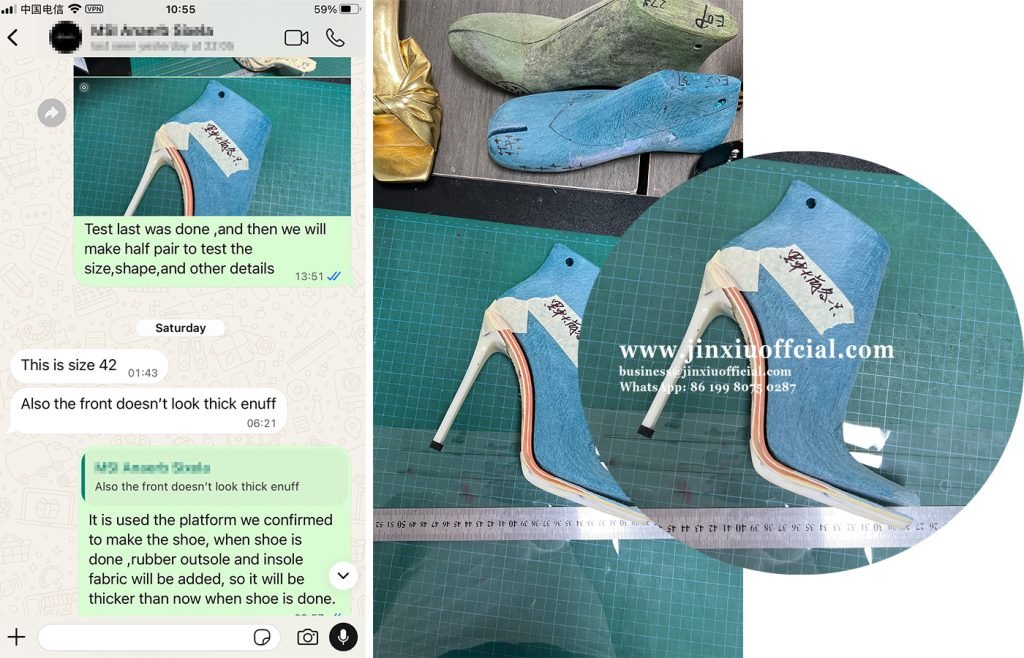
A base size is the reference size used as the starting point for development and subsequent grading.
For JINXIU’s women’s footwear projects involving a new last and new style, we typically start with EU 37 / US 7. This is our usual development practice.
The initial sample brings the last, upper patterns, materials, and components together so that we can review how the design works as a physical shoe.
It gives our team a consistent starting point for identifying issues before extending the design to other sizes.
3. Conduct Fit Testing and Make Adjustments

We arrange fitting with a professional fit model and combine the fitting results with our technical team’s assessment and the buyer’s feedback.
Depending on the style, the review may include:
- Toe room and forefoot width.
- Space around the instep.
- Heel, arch hold, and foot retention.
- Strap placement and closure function.
- Pressure points and movement during wear.
- The relationship between the last, heel, and platform.
- The overall silhouette and design proportions.
The buyer’s design feedback and the physical fitting assessment serve different purposes. Photos and videos help communicate appearance and development progress, while fitting provides information about how the sample behaves on a foot.
If a problem is identified, we adjust the relevant part of the development. This may involve the last, upper pattern, strap position, or construction.
Where needed, the sample is remade and fitted again before moving forward.
Usually, the revision takes 2-4 rounds.
4. Approve the Base-Size Fit and Design
Before shoe size grading begins, we confirm that the base-size development is ready to move to the next stage.
That review covers both fit and design: the sample should reflect the agreed silhouette, proportions, structure, and relevant angles, alongside the results of fitting.
Base-size approval is a development milestone. It does not mean that every other size has already been validated.
For example, an approved EU 37 sample provides the basis for developing EU 42. The EU 42 sample still needs to be made and reviewed in its own size.
5. Grade the Last and Patterns to the Required Size
Shoe size grading is the process of developing other sizes from the approved base, using the agreed sizing requirements and grading rules.
It is more involved than enlarging the entire shoe by a single percentage.
The last and upper patterns need to work together as dimensions change. Depending on the design, the technical review may also involve strap lengths, opening dimensions, fastening positions, and the relationship between the upper and bottom components.
Heels, platforms, and soles also need to be checked for the intended sizes. A component that works with the base-size sample should not automatically be assumed to fit every size in the collection.
This is why we ask about the planned commercial size range early in custom shoe sample development.
6. Produce and Review the Buyer’s Requested Sample Size
After grading and the relevant component checks, we produce the sample in the requested size—for example, EU 42.
This sample allows the buyer to review the design in the size they actually need. Fit evaluation should involve a wearer whose foot measurements are appropriate for the intended size and fit requirements.
The review considers whether the graded shoe provides the intended fit, maintains suitable proportions, and works correctly with its components.
Further adjustments may still be necessary. Approval of the base size reduces unresolved questions at the starting point, but it cannot guarantee identical fitting results across the size range.
Likewise, approval of one requested-size sample should not be treated as automatic approval of an entire bulk size run.
Why We Validate the Base Size Before Making the Requested Size
Base-size development takes additional work. We keep this stage in our shoe sample development process because it helps us identify underlying problems before carrying them into another size or mass production.
1. An Additional Sample Creates Real Work and Cost
Sample making requires concentrated attention from skilled staff. Cutting, stitching, assembling, fitting, and revising a single design involve substantial manual work and material use.
During these tasks, the people responsible need to focus on the sample. That time cannot simply be treated as spare capacity alongside other production work. Small development quantities also offer fewer opportunities for the efficiencies available in bulk production.
Our sample quotations generally follow a fixed-price approach based on the type of style and the agreed development scope. We do not individually calculate and charge for every material input or minute of work involved in each design.
That means an additional internal development step does not automatically generate an additional fee. Within the agreed scope, it adds work and cost for us.
We also want samples to move forward efficiently. There is no commercial benefit in adding unnecessary work that we cannot charge for separately. We retain the base-size stage because we consider it necessary for this type of new last development.
2. Early Fit Testing Helps Prevent Larger Revisions Later
A new last and a new design introduce several related variables. The last shape, upper pattern, materials, heel position, and other components must work together.
If we move directly to the requested size without validating that relationship, the final sample may carry problems that originated in the initial development.
Based on our development experience, reviewing the base size first helps make subsequent corrections more focused. Adjustments may still be needed, but we have already assessed the underlying fit, structure, and proportions.
When that review is skipped, there is a greater risk that the buyer’s sample will need broader changes—for example, revising the last shape, reworking the pattern, or reconsidering the relationship between the heel, platform, and upper.
Where dedicated tooling is involved, substantial changes may also require tooling modification or replacement. Identifying problems earlier can reduce the risk of investing further work in a development that still needs a fundamental correction.
3. Base-Size Approval Still Leaves Room for Brand-Specific Adjustments
Every brand has its own expectations for fit and silhouette. Two brands using the same size label may still expect different toe room, forefoot width, instep volume, or heel hold.
For that reason, an approved base-size sample does not mean the buyer’s requested-size sample will need no further work.
We support revisions after sample evaluation. The purpose of base-size testing is to establish a sound starting point so that later feedback can focus more closely on the brand’s requirements.
Some minor changes may be suitable for incorporation into the pre-production sample or agreed bulk specifications. Changes that affect fit, structure, or component compatibility need further review and, where necessary, another physical sample before bulk production.
This is why we validate the base size first: to resolve as much as possible at the development stage, while preserving a clear opportunity to evaluate and refine the size the buyer actually needs.
Frequently Asked Questions
1. Is EU 37 the standard base size for every shoe manufacturer?
No. Base sizes vary by manufacturer. EU 37 is the size JINXIU typically uses as the starting point for the women’s footwear development described here.
2. If I request EU 42, will I still receive an EU 42 sample?
Yes. The EU 37 sample is the initial development reference. After base-size approval and grading, we produce the agreed EU 42 sample and ship it for further review. You will not receive the EU 37 shoe.
3. Does an approved EU 37 sample guarantee that EU 42 will fit correctly?
No. Base-size approval establishes the starting point for grading. The requested size still requires evaluation from the buyer’s test, especially when the size difference or construction introduces additional fitting considerations.
4. Does every sample order require new base-size development?
Usually, it is at JINXIU. JINXIU does not recommend proceeding with the production of samples or bulk orders based on estimated figures derived from guesswork; therefore, we typically adhere strictly to the process of creating a base size/ base desigsn first. However, if the buyer wishes to make minor modifications to an existing design, we will first assess the feasibility before deciding whether to proceed with the adjustments directly.
Planning Custom Shoe Samples for Your Brand?
When discussing a new project with JINXIU, share your design references, requested sample size, planned bulk size range, and any existing fit specifications.
We can then explain the development stages your project requires, from the base-size fit sample to grading and requested-size review.
A clear process helps both teams understand what is being developed, what needs approval, and when the project is ready to move forward.


