Why an Existing Platform May Not Fit Your High-Heel Design

Platform high heel development may appear straightforward when a buyer sends a reference image and similar platforms and heels already seem to exist in the market.
Then the manufacturer asks for the complete production size range and explains that a new mould may be required if no suitable existing platform can be found.
The buyer may naturally wonder: “If platforms and heels are already available in different sizes, why would we need a new mould?”
The short answer is that market availability and structural compatibility are not the same thing.
A platform marked with the correct size may still have the wrong outline, width, toe spring, bottom curve or grading proportions for the selected shoe last. A component that works for the sample size may not be available for every bulk-production size. A platform seen on another brand’s shoe may also belong to privately funded tooling that is not available for public use.
For this reason, a responsible footwear manufacturer should evaluate the last, platform, heel and complete production size range before confirming the development plan.

Platform High Heel Development Starts with Structural Matching
In an ordinary conversation, the shoe last, platform, and heel may sound like three separate components. During footwear development, however, they must work together as one structural system.
The manufacturer needs to evaluate:
- The length, width, and forepart outline of the last bottom;
- The toe shape and edge profile of the platform;
- The platform thickness, bottom curve and toe spring;
- The heel height, heel seat and heel position;
- The pitch and load-bearing angle of the complete shoe;
- The relationship between all these elements across the graded size range.

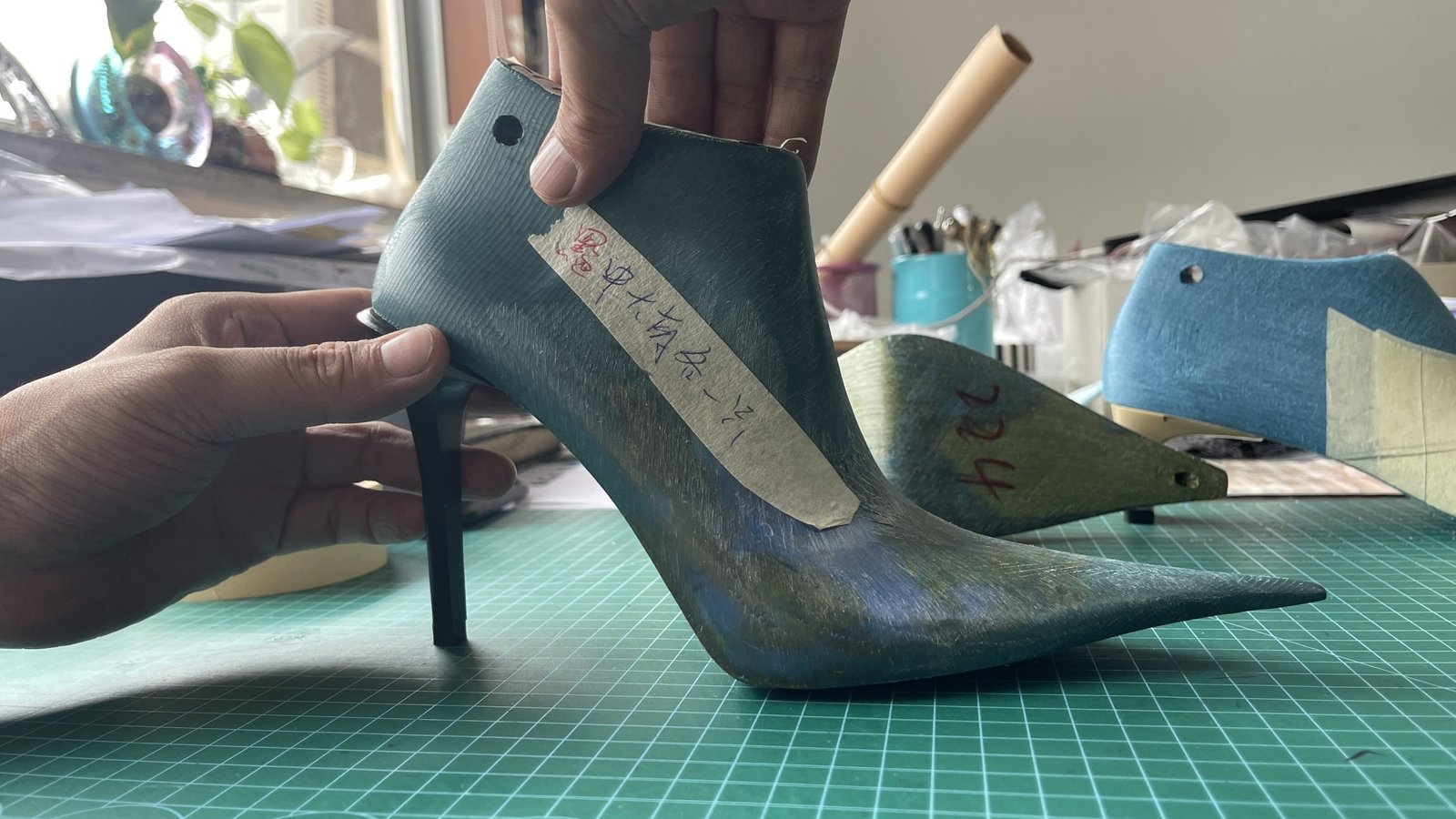
Strictly speaking, the heel shown in the above image is unsuitable for a shoe with a platform—even one as thin as 5mm. However, if a buyer insists on adding a platform, or if a factory agrees to cut costs and secure the order, the shoe can indeed be manufactured that way. The result, however, will be a shoe with an unbalanced silhouette; more importantly, prolonged wear—such as walking for several hours—will likely cause noticeable foot pain or even joint injury, making it impossible to continue walking.
“Available” Does Not Always Mean “Compatible”
When reviewing an existing platform or heel, the information visible to the buyer is only the beginning. The manufacturer must still verify whether the component is usable for the specific project.
| What the buyer may see | What the manufacturer still needs to verify |
|---|---|
| Platforms are available in EU sizes 35–42 | Whether the bottom outline, forepart width and toe shape match the selected last |
| The platform height looks similar | Whether the bottom curve, toe spring, thickness and forepart angle are compatible |
| The heel height is the same | Whether the heel seat, heel position and load-bearing angle match |
| The platform works for the sample size | Whether corresponding components are available for every bulk-production size |
| The component was produced before | Whether the original mould still exists and remains suitable for production |
| A supplier has a physical sample | Whether a complete production mould set and graded size range still exist |
| Another brand has used the component | Whether it is an open-market mould or privately funded tooling owned by that brand |
| The component is marked Made in China | Whether the manufacturer has the right and practical ability to access it |
| A component carries the same numerical size | Whether its last shape, girth, width, and grading standard suit the target market |
| Existing sizes cover China or some Asian markets | Whether they also cover the larger sizes required for US or European orders |
This distinction is important because a sample can sometimes be forced together using components that are only approximately compatible. The result may look acceptable in a photograph, but that does not prove that the structure is correct or that the same construction can be reproduced consistently in bulk production.

For instance, if the heel is designed for a 1 cm platform, we cannot simply swap it for a 0.7 cm or 1.5 cm one, as this would alter the angle; if a platform of a different thickness is used, the heel height must be adjusted accordingly to ensure a proper match. They are a matched pair.
Sample Feasibility Is Not Bulk-Production Feasibility
The sample size is only one size. A production order normally requires a complete graded range.
A supplier may have a suitable platform in the sample size but lack one or more of the required production sizes. In other cases, a physical component may remain in a showroom even though the complete mould set is no longer available.
If this is not checked before sampling, the buyer may approve and pay for a sample only to discover later that some sizes cannot be produced reliably.
That is why manufacturers need to request the full size range at the beginning of the project—not just the sample size. Availability for the sample size does not mean availability for the complete bulk size range.
Early verification protects both sides from investing time and money in a sample that cannot move into production.

A Mould That Existed Before May No Longer Be Available
The fact that a component supplier produced a particular platform, heel or outsole in the past does not necessarily mean that the original mould is still available today.
Moulds require storage space and maintenance. Tooling that has generated no orders for several years, belongs to a discontinued product or is no longer commercially useful may eventually be removed or scrapped by the mould factory.
As a result, a manufacturer may find an old platform in a supplier’s catalogue, showroom or sample archive, but later discover that the production tooling is incomplete or no longer exists.
If the original tooling has been scrapped, reproducing the component is not simply a matter of restarting an old order. Some sizes—or the entire mould set—may need to be made again, creating new tooling costs and additional development time.
Before confirming that an existing component can be used, the manufacturer therefore needs to verify:
- Whether the original mould still exists;
- Whether it remains in production-ready condition;
- Which sizes are still available;
- Whether a complete graded set exists for bulk production;
- Whether restarting production requires a minimum order quantity;
- Whether the tooling needs to be repaired, supplemented, or remade for mass production, and then the buyer can evaluate the investment.
Produced before does not mean available for production today.
Why Larger US and European Sizes Require Additional Checking
China’s footwear-component market serves both domestic and export production. However, many open-market platforms, heels and outsoles are developed around the size ranges most commonly ordered in the Chinese domestic market.
For women’s footwear, the most common domestic range is approximately CHN 35~39. For men’s footwear, it is generally CHN 39~44. The selection of existing components and complete mould sets decreases significantly outside these regular ranges, particularly for large and extended sizes.
Some existing Chinese components may be easier to use for China and selected Asian markets because their common size ranges and certain fitting characteristics are relatively close. Compatibility must still be checked against the buyer’s actual last and sizing standard; it should never be assumed automatically.
For US and European orders, the difference may involve more than larger size numbers. Manufacturers may also need to consider:
- A wider or differently shaped forepart;
- Different girth and last proportions;
- A broader production size range;
- Half-size requirements;
- Different grading standards;
- Limited availability of large and extended-size components.
Molds actually manufactured to US or European size specifications account for a very small proportion—they are the exception rather than the rule. Consequently, we often perform a matching process behind the scenes, though this is something the buyer would not be aware of.
Even when both a shoe last and a platform carry the same EU size marking, their length, width, bottom outline and grading proportions may still differ.
Platform high heels intended for US or European markets must therefore be checked against the buyer’s actual last and full production size range. The same numerical size does not guarantee the same shape, fit, or grading standard.

“Made in China” Does Not Mean Open-Market Availability
A buyer may see a particular platform or heel on another brand’s website and know that the shoe was made in China. It is understandable to assume that another Chinese manufacturer should be able to obtain the same component.
In practice, this is not always possible.
Many distinctive platforms, heels and outsoles are developed using privately funded moulds. The brand that paid for the tooling may control its use through an ownership agreement, exclusivity arrangement or manufacturing contract.
The mould factory should not supply that tooling to an unrelated customer without authorization. Personal relationships with the supplier do not remove these commercial and intellectual-property obligations.
Responsible manufacturers should not copy or use privately funded tooling belonging to another brand without permission.
Therefore, made in China describes the place of manufacture; it does not establish that the component is publicly available to every factory in China.
When Is a New Mould Actually Required?
A new mould should not be the automatic starting point for every platform high-heel project.
The practical first step is to search for an existing platform and heel set that can meet the design, structural and sizing requirements. If a suitable set is available, using it can reduce development cost, shorten the timeline and lower the project risk.
Custom tooling may need to be considered when:
- No existing platform matches the required last and design;
- The desired shape, height or surface construction is unique;
- Existing components cover only part of the required production size range;
- The original mould has been scrapped or is no longer production-ready;
- The available tooling belongs to another brand and cannot legally be used;
- Design adjustments would change the intended product too significantly.
The manufacturer should explain which components require new tooling, how many sizes are involved, the expected mould cost, the development time, and any related production conditions.
No custom mould should be made without the buyer’s approval.
A Practical Development Process In Sampling
At JINXIU, the purpose of the early technical review is to determine whether the design can move from an attractive reference image to a workable sample and then into reliable bulk production.
For a platform high-heel project, the process normally includes the following steps.
- 1. Confirm the Project Requirements
We review the reference images or technical drawings, sample size, complete bulk size range, heel height, platform specifications, target materials, expected quantity, and acceptable level of design adjustment.
- 2. Search for Existing Components
We first check the open market and our cooperating component suppliers for the closest available platforms and heels.
- 3. Check the Actual Structural Match
Finding a visually similar platform is not enough. The component must be checked against the selected last and heel construction, including the outline, pitch, toe spring, heel seat and balance.
- 4. Verify the Complete Size Range
We confirm whether the required moulds remain available for every production size, not only the sample size.
- 5. Present the Available Options
Depending on the result, the buyer may choose to:
- Use a suitable existing mould set;
- Use the closest existing platform and make a reasonable design adjustment;
- Adjust the heel height, platform shape or surface finish;
- Limit production to the sizes covered by the available moulds;
- Develop dedicated new tooling when required;
- Pause the project if neither the existing options nor the tooling budget is suitable.
Conclusion:
The Goal Is Reliable Production, Not Just One Sample
When a footwear manufacturer asks detailed questions about the last, platform, heel, and size range, it does not necessarily mean that the manufacturer is trying to introduce a new mould cost or push you on making a new mould.
The purpose is to determine:
Whether an existing component is structurally compatible;
- Whether the required moulds still exist;
- Whether they can cover the complete production size range;
- Whether they are legally and commercially available;
- Whether the finished shoe can maintain the intended appearance, balance and comfort.
This evaluation is not intended to make the project more complicated. It is intended to make the available choices and production limitations clear before unnecessary costs are incurred. What is most important is that the buyer can move to bulk production after the sample is approved, rather than being informed of a sudden budget increase for new molds only when preparing to place a large production order, or the factory sidesteps mold-related issues and improperly uses existing molds, thereby compromising the quality of the shoes.
Planning a Platform High-Heel Project?
If you are developing platform heels or another structurally complex footwear design, send us your reference images, target market, sample size, complete production size range, expected quantity, and material requirements.
JINXIU can help evaluate existing component availability, structural compatibility, and bulk-production feasibility before sampling begins.