Why Are Chinese Shoes So Cheap? Cost-Cutting Explained
Why Are Shoes Sourced from China So Cheap? Sharing Common Cost-Cutting Practices to Avoid
When quoting prices to clients, we often hear, Another supplier offered me a much lower price. However, based on our decades of experience in shoe production and sales, such low quotes are often unrealistic. At those prices, factories would likely lose money rather than make a profit.
For unprofitable orders, a one-off or occasional loss might be acceptable, especially in long-term partnerships. A factory might break even on one order but profit from another. However, consistently low prices raise red flags about quality and sustainability.
When we started selling on a certain platform, we produced many samples, but very few led to bulk orders. Clients would take a single sample and request quotes from ten local suppliers, choosing the cheapest option. The truth is, price and quality are closely linked. When clients demand low prices for small orders, suppliers often resort to cost-cutting measures. Drawing on our family’s 20+ years in the industry, here are some common—but problematic—ways suppliers reduce costs:
Note: These are incorrect cost-cutting methods, yet they are widely used in the industry.
1. Using Lower-Grade Materials
Suppliers may substitute high-grade materials with lower-grade ones. The difference is not always visible to the naked eye, as material grades vary in subtle ways:
-
- Leather quality: Lower grades may differ in thickness, tear resistance, or resistance to yellowing (especially for white materials under sunlight). They may also contain non-eco-friendly components or heavy metals.
-
- Impact: Shoes made with inferior materials wear out faster, affecting durability and customer satisfaction.
2. Reducing Midsole and Heel Quality
This is especially common in high heels. Materials designed to support 150 kg will cost significantly more, sometimes 50% more than those rated for 100 kg or 70 kg. Suppliers rarely disclose this to buyers, compromising the shoes stability and comfort.
3. Domestic vs. Imported Materials
Imported materials are typically more expensive than domestic ones. While China is a manufacturing powerhouse with high-quality domestic materials, many factories prioritize cost over quality. High-end domestic materials exist but are pricier, and most brands would not pay for the premium. As a result, factories often use cheaper local materials to keep costs down, which can affect quality.
Like ours zippers, are always from the YKK company, which is from Japan and is well known as its global quality system.


For foam,we only use high-reboned and high-density foam from the company which is working with Adidas, Prada, Nike,and Dr.Martens,the company works with more than 550 luxury world brands. The deep blue one is the one we are using,we do not the light blue one.
4. Cutting Costs by Reducing Mold
Molds are a significant expense in shoe production, especially for small orders. High-quality, refined shoes require multiple molds (e.g., steel molds for outsoles, midsoles, insoles, or plastic molds for cut pieces). For example:
-
- A full set of molds for five sizes might cost $120 (or more for complex designs).
-
- For a 50-pair order, molds add $2.40 per pair; for 30 pairs, it rises up to $4 per pair.
-
- At a shoe price of $30, this is a substantial cost. To save money, factories may skip molds, opting for hand-cutting, which leads to inconsistent quality. Some flaws are visible; others are only noticeable to experts, but customers will sense the lower quality.

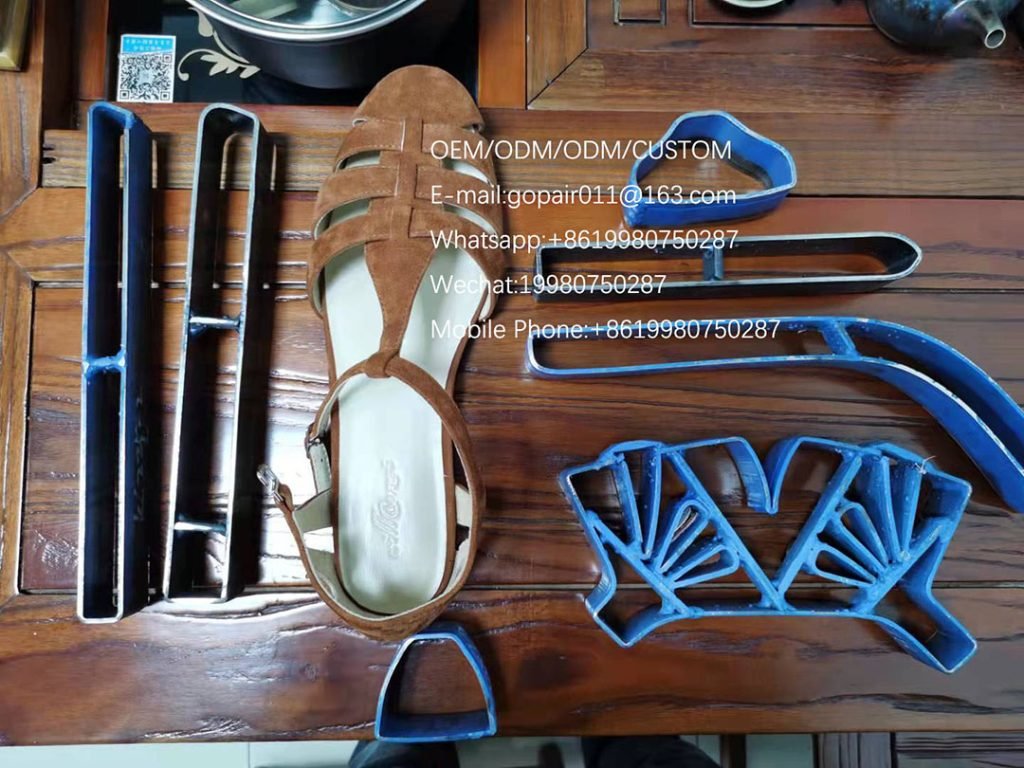
If we want to keep the insole look smooth and beautiful, we will make moudls for it, but if we want to save cost, we can draw it by hand,b ut the edge will not be good for a high-quality shoe.
5. Mislabeling Sizes

In international orders, especially for shoes, half-sizes (e.g., US 9.5) are common, but Chinese sizing typically uses whole sizes. To cut costs, some factories use the same mold for both whole and half sizes (e.g., labeling US 9 and 9.5 with the same mold). This is hard to detect visually, especially in boots, but results in ill-fitting shoes. For one-off orders with no reorders, factories may justify this to avoid expensive mold production, as buyers often won’t accept higher prices for proper sizing.
A real example:
In 2024, a factory owner (A) shared a story of her client (B) who running an online store. to us. A Greek buyer (C) requested a shoe in US sizes, but B’s existing molds were in European sizes. For a small 30-pair order, B asked factory A to use European molds but label them as US sizes. Factory A refused, knowing this would cause significant issues for C, who would market the shoes as US sizes. Customers would receive smaller-than-expected shoes, leading to returns and delays (e.g., 3 months to sell instead of 1 month). This caused tension, as B felt A’s refusal cost them the order, despite their long partnership.
Are you willing to meet the kind of selle B?
6. Using Stale or Overstocked Materials
To clear inventory and recover funds, factories may use old, overstocked materials. These are sold at lower costs, reducing the shoes price, but the quality suffers due to prolonged storage. Shoes made from such materials often fall short of standard quality levels.
7. Selling at Cost Price (Rare)
Some factories, especially for large orders, sell at cost or slight loss to boost sales volume. This is rare and depends on luck, as it is tied to government export incentives like tax refund. These factories profit from policy benefits, not buyers.It is also happening in china, but less oppertunity for meeting by samller business buyers ,or even some big wholesale buyers,Most factories, however, rely on buyer margins for profit, making this approach uncommon.
That is all for today! If you have questions or want to dive deeper, feel free to reach out us and love to discuss further.
Check the pages below to know more about JINXIU and choose the right business partner
Related Sourcing More Buyer Guides, Master Your Supply Chain